Together we can make Sandown stronger, fairer and more Resilient!
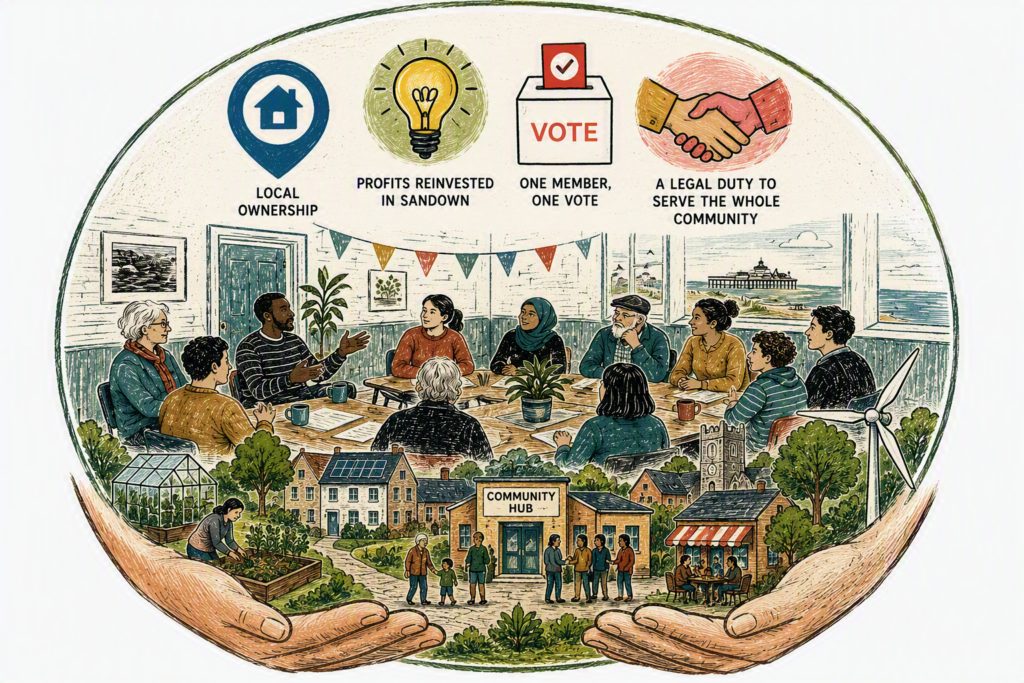
What is a Community Benefit Society?
Building projects for people, not profit.
A Community Benefit Society is a type of co-operative legal structure.
These organisations are often involved in providing local services, affordable housing, renewable energy projects, or the running of pubs, shops, and cultural venues that might otherwise close.
They are run by members of the by the community, for the community, not a public body.
Key features include:
• Open and voluntary membership.
• Democratic control: one member, one vote.
• Profits must be used for community purposes or reinvested into the society’s objectives.
• Asset lock provisions, which prevent the distribution of assets to members.
CBSs must be registered with the Financial Conduct Authority (FCA) and as such are regulated.
10 Steps to Build a Community Benefit Society

1. Define the Purpose and Community Benefit
Objective
- Clearly state the social, environmental, or economic benefit the society exists to deliver.
- Identify the community of benefit (geographic area or group of people).
Key Actions
- Write a concise mission statement.
- Define the specific problem or unmet need you are addressing.
- Ensure benefits are primarily for the wider community, not just members.
Outputs
- Mission and values statement.
- Description of community impact.
2. Engage the Community and Stakeholders
Objective
- Ensure the society is rooted in real community need and has local support.
Key Actions
- Hold community meetings, workshops, or surveys.
- Engage key stakeholders (residents, voluntary groups, councils, businesses).
- Identify potential founding members.
Outputs
- Evidence of community demand.
- List of supporters and founding members.
- Summary of consultation findings.
3. Define Activities and Services
Objective
- Translate your mission into practical, deliverable activities.
Key Actions
- Specify products or services to be provided.
- Explain how activities create measurable community benefit.
- Identify beneficiaries and access arrangements.
Outputs
- Activity plan.
- Theory of change or impact logic model.
4. Establish Governance and Membership Structure
Objective
- Create a democratic, transparent governance framework.
Key Actions
- Define membership eligibility and rights.
- Determine board structure and roles.
- Decide on sub-committees or advisory groups if required.
Outputs
- Governance structure chart.
- Membership policy.
- Role descriptions for directors.
5. Legal Formation and Registration
Objective
- Formally register as a Community Benefit Society.
Key Actions
- Choose an appropriate model constitution or rules.
- Ensure asset lock provisions are included.
- Register with the Financial Conduct Authority (FCA).
Outputs
- Registered rules.
- FCA registration confirmation.
- Society registration number.
6. Financial Model and Funding Strategy
Objective
- Ensure financial sustainability while delivering community benefit.
Key Actions
- Develop startup and operating budgets.
- Identify income streams (trading, grants, contracts, community shares).
- Decide whether to issue community shares.
Outputs
- 3–5 year financial projections.
- Funding and investment strategy.
- Community share offer (if applicable).
7. Operations and Delivery Planning
Objective
- Ensure the society can operate efficiently and compliantly.
Key Actions
- Define staffing and volunteer needs.
- Establish policies (safeguarding, equality, data protection).
- Set up systems for finance, reporting, and risk management.
Outputs
- Operational plan.
- Key policies and procedures.
- Risk register.
8. Impact Measurement and Reporting
Objective
- Demonstrate accountability and community value.
Key Actions
- Define success metrics and indicators.
- Collect qualitative and quantitative impact data.
- Plan regular reporting to members and funders.
Outputs
- Impact framework.
- Annual impact report template.
9. Launch and Growth Strategy
Objective
- Successfully launch and build long-term resilience.
Key Actions
- Plan communications and marketing.
- Recruit members and partners.
- Identify opportunities for scaling or replication.
Outputs
- Launch plan.
- Growth and sustainability strategy.
10. Review and Continuous Improvement
Objective
- Ensure the society evolves with community needs.
Key Actions
- Schedule regular board and member reviews.
- Update strategy based on learning and feedback.
- Maintain compliance and good governance standards.
Outputs
- Annual review process.
- Continuous improvement plan.